I get a lot of questions asking how to delete the default folders, such as Junk Email, RSS, Conversation History, Archive, and Suggested Contacts. Microsoft Outlook creates these folders in the default data files. While I don't recommend deleting the default folders, anyone who really wants to delete default folders can delete them using MFCMAPI or OutlookSpy.
You can rename the defaults folders using the method at Rename default folders.
Deleting folders using these tools is usually not permanent: at some point in the future, Outlook may decide to recreate the folder. It may be weeks, it may be months, but it often comes back. Exactly how long it stays gone depends on the folder, Outlook recreates some folders fairly quickly.
PowerShell script to hide folders is here. A macro to hide folders is at the end of this article. Add it to the QAT to easily re-hide folders when Outlook unhides them. To hide a number of folders at once, in all data files, see Hide Extra Folders in Outlook.com
In most cases, it's better to hide the folder. Outlook seems less inclined to remove the Hidden tag from the folder (although lately it is removing the hidden tag from calendar folders within a couple of hours.). However, hiding a folder does not stop Outlook from using it. If you hide Junk email, RSS, or Suggested Contacts folders, you need to disable the features that use those folders.
Before using MFCMAPI or OutlookSpy, you should make a copy of your data file! While these steps are safe to use, it is very easy to have an "Oops, did I do that?" moment and lose your data.
Which folders are candidates for deletion or hiding? Junk Mail (only if its disabled first), RSS and Suggested Contacts (after disabling it in File, Options, Contacts).
Using scanpst or the /resetfolder switch may recreate the folders.
To use either method, get MFCMAPI. You'll need the 32-bit version if you use Outlook 2007, or Outlook 2010 and up in 32 bit. The 64-bit version is for use with Outlook 64-bit (NOT 64-bit Windows).
These instructions remove or hide default folders in a PST file. The process is similar with Exchange mailboxes, however, the missing folders are more likely to be recreated and removing them is not recommended.
Delete the Folder
- After downloading MFCMAPI, unzip it then double click to run.
- Click Session > Logon and choose your profile (if you have more than one)
- Double click on your data file. If you have more than one data file, the top one should be your default. (It will have True in the Default Store column.)
- Expand Root Container (or Root - Mailbox if using Exchange)
- Expand Top of Outlook Store. Exchange users will choose IPM_SUBTREE
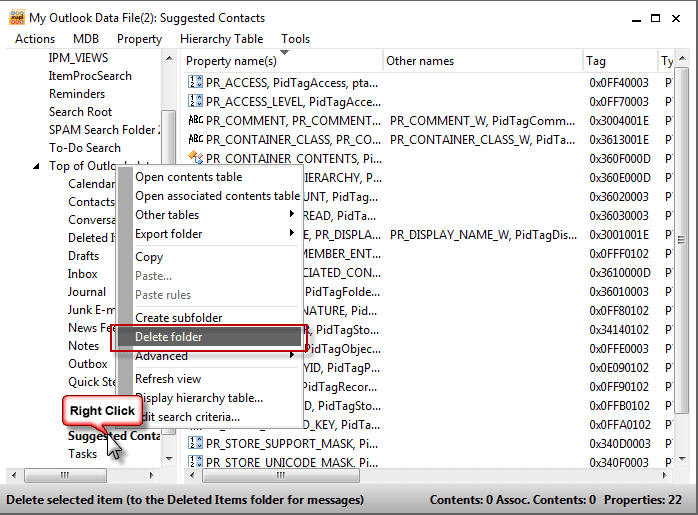
- Select the folder you wish to delete.
- Right click and choose Delete Folder.

- Click OK. (Don't tick Hard Deletion, it doesn't work on most folders.)
- Close the dialogs and return to Outlook.
Hide the Folder
The macro at the end of this article automates these steps to hide the selected folder. If you accidentally hide the wrong folder, you'll need to use MFCMAPI to unhide it. Find the Hidden property and remove the tick from the Boolean field.
- After downloading MFCMAPI, unzip it then double click to run.
- Click Session > Logon and choose your profile (if you have more than one)
- Double click on your data file. If you have more than one data file, the top one should be your default. (It will have True in the Default Store column.)
- Expand Root Container (or Root - Mailbox)
- Expand Top of Outlook Store (or IPM_SUBTREE)
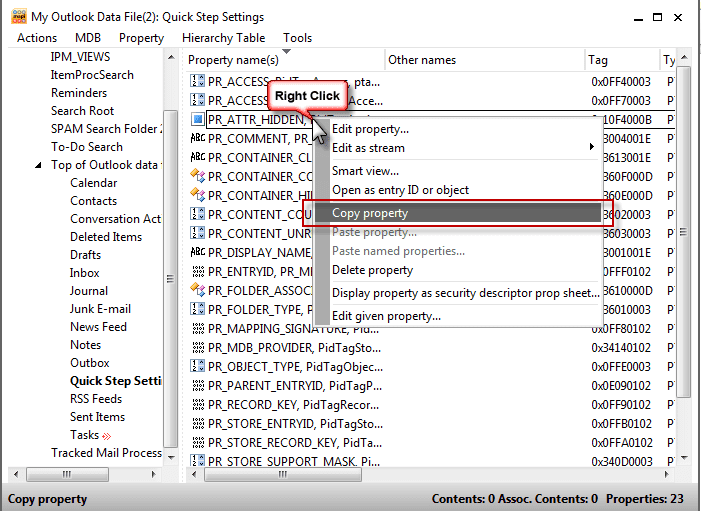
- Select Quick Step Settings folder
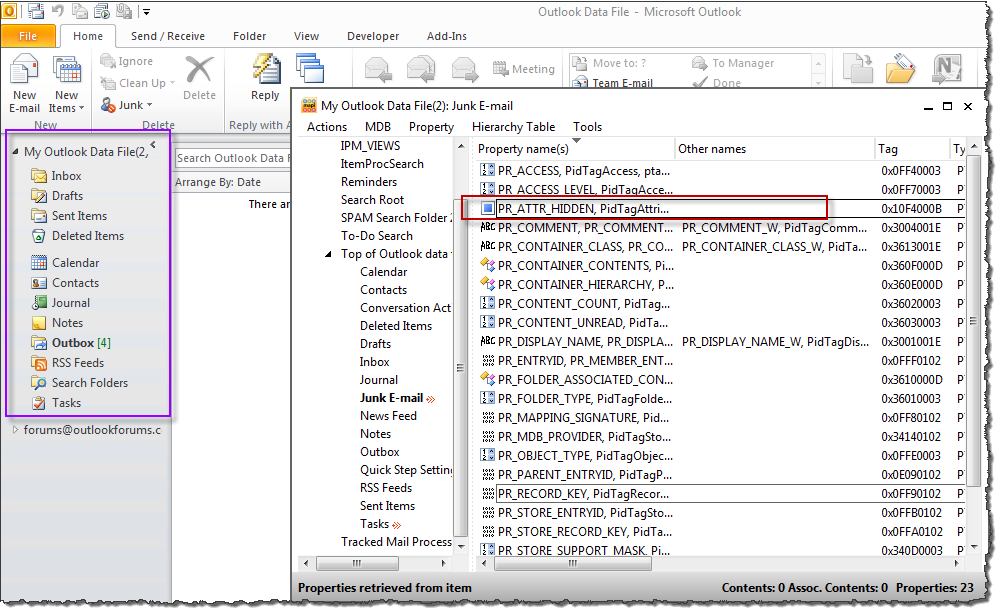
- Select "PR_ATTR_HIDDEN, PidTagAttributeHidden, ptagAttrHidden" entry (near the top)
- Right click and choose Copy Property
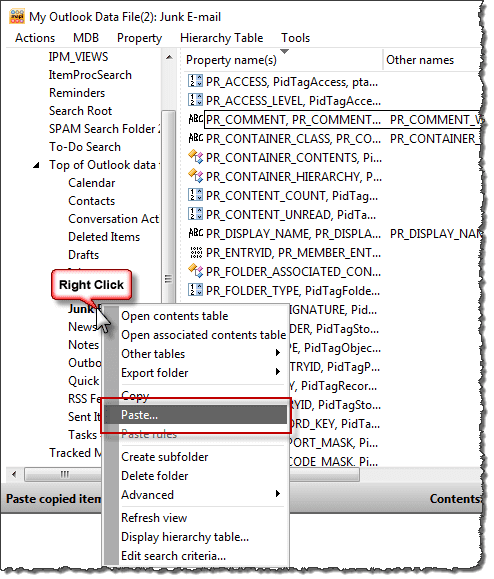
- Select the folder you wish to hide.
- Right click and choose Paste...
- Click OK twice to add the property to the folder.
- Close the dialogs and return to Outlook.
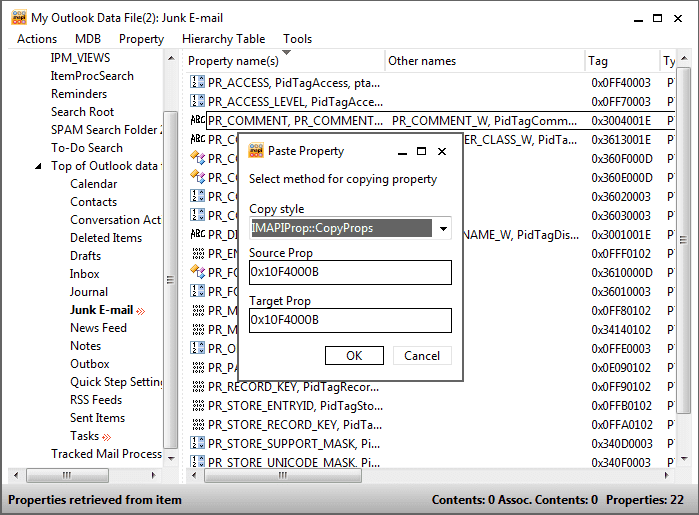
This screenshot shows the PR_ATTR_HIDDEN, PidTagAttributeHidden, ptagAttrHidden property added to the folder's property as well as the folder list without the Suggested Contacts folder (deleted) and Junk mail folder (hidden).
Use OutlookSpy
You can hide folders using OutlookSpy in 5 clicks:
- Select the Clutter folder
- Click IMAPIFolder button on the OutlookSpy ribbon
- Click “Add Property” button
- Type PR_ATTR_HIDDEN in the tag edit box and true in the value edit box
- Click OK
Restore a hidden folder
If you hid a folder and now need to unhide, you'll need to use MFCMAPI or OutlookSpy to remove the hidden folder. (If you are using Exchange cached mode and the folder appears in OWA, you can delete the ost file to restore the folder.)
- Open MFCMAPI.
- Go to Session, Logon.
- Double-click on the email account then Tools, Options and select “Use the MDB_ONLINE flag when calling OpenMsgStore”.
- Close then reopen the dialog box and Expand ‘Root Container’
- Expand “Top of Information Store”.
- Click on folder you need to unhide then Double-click “PR_ATTR_Hidden…” attribute.
- Check “Boolean” then OK
- If using Exchange or Office 365, verify that OWA did not display the folder.
- Then uncheck ‘Boolean’ and click OK to hide again. Check OWA.
- Start Outlook.
Manually Add the Property Tag using MFCMAPI
While it's easier for many people to copy and paste the property tag or use the macro, you can add the Hidden property tag to any folder using MFCMAPI.
- Get the property tag (0x10F4000B)
- Open MFCMAPI to the folder you want to hide
- Right-click an choose Edit Given Property
- Type or Paste the property into the Property name field and click Ok.
- Click Boolean then click OK to finish.
Tools
Utility hide unused folders in Outlook data files, include RSS, Calendar and Contacts in other .pst files. | |
MFCMAPI uses Microsoft's published APIs to provide access to MAPI stores through a graphical user interface. Its purpose is to facilitate investigation of Exchange and Outlook issues and to provide developers with a canonical sample for MAPI development. Updated frequently. |
Use PowerShell to Hide or Unhide a Folder
This PowerShell sample will hide or show a folder.
$Outlook = New-Object -comobject Outlook.Application
$ns = $Outlook.GetNameSpace("MAPI")

$PropName = "http://schemas.microsoft.com/mapi/proptag/0x10F4000B"

#hide the selected folder
#$Folder =($Outlook.ActiveExplorer()).CurrentFolder

#hide or unhide a default folder (Journal in this case)
$Folder = $ns.GetDefaultFolder(11)

# hide or unhide a folder at the same level as the inbox
#$Folder = $ns.GetDefaultFolder(6).Parent.Folders.Item(".Test")

# hide or unhide a subfolder of inbox
#$Folder = $ns.GetDefaultFolder(6).Folders.Item(".Test")

write-host $($Folder.Name)
$oPA = $Folder.PropertyAccessor
$value = $oPA.GetProperty($PropName)
write-host $Indent$($Folder.Name)" ("$($Folder.Items.Count)")" $value

# true = hidden, false = visible
# check to see if hidden and change to visible
If ($value -eq $true)
   {
   write-host "changing prop"
    $oPA.SetProperty($PropName, $false)
    }

$value = $oPA.GetProperty($PropName)
write-host $Indent$($Folder.Name)" ("$($Folder.Items.Count)")" $value
Hide Calendar and Contacts folders in Shared Mailboxes
This version of the script hides the Calendar or Contacts folders in Exchange shared Mailboxes. To get a list of mailboxes it will apply to before running the script, remove or comment out this line.
$oPA.SetProperty($PropName, $true)
$Outlook = New-Object -comobject Outlook.Application
$ns = $Outlook.GetNameSpace("MAPI")

$PropName = "http://schemas.microsoft.com/mapi/proptag/0x10F4000B"

#Get all shared mailboxes
$mailboxes = $Outlook.GetNameSpace('MAPI').Stores | Where-Object {$_.ExchangeStoreType -eq 1}

#$mailboxes | Select DisplayName, SmtpAddress

foreach ($mailbox in $mailboxes) {

$mailboxname = $mailbox.displayname
write-host $mailboxname

$store=$ns.Stores.Item($mailboxname)

#calendar = 9, contacts = 10
$HideFolder = $store.GetDefaultFolder(9)

write-host $($HideFolder.parent.Name)

$oPA = $HideFolder.PropertyAccessor

$value = $oPA.GetProperty($PropName)

# true = hidden, false = visible
# check to see if hidden and change to visible
If ($value -eq $false)
   {
   write-host "changing prop"
    $oPA.SetProperty($PropName, $true)
    }

$value = $oPA.GetProperty($PropName)

}
Valid ExchangeStoreType Enumeration values:
| ExchangeStoreType | Value | Description |
|---|---|---|
| olAdditionalExchangeMailbox | 4 | Specifies an additional Exchange mailbox store. |
| olExchangeMailbox | 1 | Specifies an Exchange delegate mailbox store. |
| olExchangePublicFolder | 2 | Specifies an Exchange Public Folder store. |
| olNotExchange | 3 | Specifies that the store is not an Exchange store. |
| olPrimaryExchangeMailbox | 0 | Specifies a primary Exchange mailbox store. |
Using PowerShell Scripts
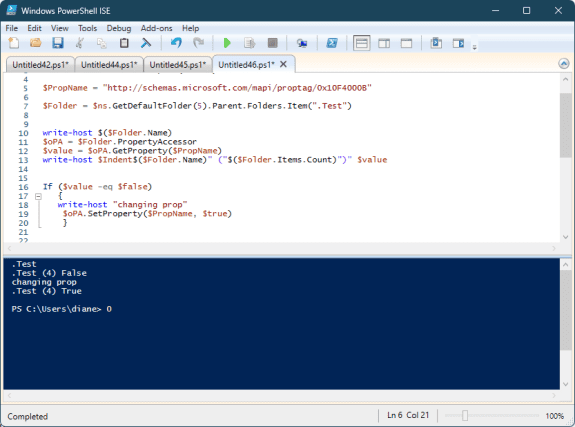
To use PowerShell scripts with Outlook, start typing PowerShell on the start menu and open Windows PowerShell when it comes up. Windows PowerShell ISE has a script pane at the top, which is useful if you want to edit the script.
Paste the entire script in the PowerShell window and press Enter or the Run button if using PowerShell ISE.
Note: PowerShell scripts will not work with the Windows Store version of Office. You'll need to use a VBA macro version if you have the Windows store version of Office installed.
Saving PowerShell Scripts
If you want to save the script as a .ps1 file, paste it into Notepad and save it with the extension .ps1. To open it in the PowerShell IDE, type powershell on the start menu and click on Windows PowerShell IDE when the PowerShell app is found. Paste the script in the editing window.
To use it, you need to allow local scripts by running this command:
Set-ExecutionPolicy RemoteSigned
To run your saved .ps1 file, right-click on the script and choose Run with PowerShell.
Default Folder Enumeration Values
| Name | Value | Description |
|---|---|---|
| olFolderCalendar | 9 | Calendar folder |
| olFolderConflicts | 19 | Conflicts folder. (Business Exchange server only) |
| olFolderContacts | 10 | Contacts folder |
| olFolderDeletedItems | 3 | Deleted Items folder |
| olFolderDrafts | 16 | Drafts folder |
| olFolderInbox | 6 | Inbox folder |
| olFolderJournal | 11 | Journal folder |
| olFolderJunk | 23 | Junk E-Mail folder |
| olFolderLocalFailures | 21 | Local Failures folder. (Business Exchange server only) |
| olFolderManagedEmail | 29 | Top-level folder in Managed Folders group. (Business Exchange server only) |
| olFolderNotes | 12 | Notes folder |
| olFolderOutbox | 4 | Outbox folder |
| olFolderSentMail | 5 | Sent Mail folder |
| olFolderServerFailures | 22 | Server Failures folder. (Business Exchange server only) |
| olFolderSuggestedContacts | 30 | Suggested Contacts folder |
| olFolderSyncIssues | 20 | Sync Issues folder. (Business Exchange server only) |
| olFolderTasks | 13 | Tasks folder |
| olFolderToDo | 28 | To Do folder |
| olPublicFoldersAllPublicFolders | 18 | All Public Folders folder in Exchange Public Folders. (Business Exchange server only) |
| olFolderRssFeeds | 25 | RSS Feeds folder |
Use VBA to Hide Folders
To use this macro, paste it into the VBA editor, select the folder you want to hide and run the macro. If you need help using the VB Editor, see How to use the VBA Editor for more information and screenshots.
Option Explicit

Public Sub HideFolders()

Dim oFolder As Outlook.Folder
Dim oPA As Outlook.propertyAccessor
Dim PropName, Value, FolderType As String

PropName = "http://schemas.microsoft.com/mapi/proptag/0x10F4000B"
Value = True

Set oFolder = Application.ActiveExplorer.CurrentFolder
Set oPA = oFolder.propertyAccessor

oPA.SetProperty PropName, Value

Set oFolder = Nothing
Set oPA = Nothing
End Sub
To unhide a folder, change
Set oFolder = Application.ActiveExplorer.CurrentFolder to use a specific folder and change the Value line to False.
For example, if you accidently hid the Calendar, you'll use this for the oFolder line to unhide it.
Set oFolder = Session.GetDefaultFolder(olFolderCalendar)
More information on folder paths and other default folder names is available in the following article:
Working with All Items in a Folder or Selected Items
Option Explicit

Public Sub UnHideFolders()

Dim oFolder As Outlook.Folder
Dim oPA As Outlook.propertyAccessor
Dim PropName, Value As String

PropName = "http://schemas.microsoft.com/mapi/proptag/0x10F4000B"
Value = False

' for default folder:
Set oFolder = Session.GetDefaultFolder(olFolderCalendar)

' for subfolder you created:
' Set oFolder = Session.GetDefaultFolder(olFolderInbox).Folders("folder name")

' for a folder at the same level as the inbox:
' Set oFolder = Session.GetDefaultFolder(olFolderInbox).Parent.Folders("folder name")

Set oPA = oFolder.propertyAccessor

oPA.SetProperty PropName, Value

Set oFolder = Nothing
Set oPA = Nothing
End Sub
Unhide folder in a secondary mailbox
You need to use the GetFolderPath function from https://www.slipstick.com/developer/working-vba-nondefault-outlook-folders/#GetFolderPath
To use, enter the account name and folder you need to unide.
Set oFolder = GetFolderPath("mailbox name\Deleted Items")
Public Sub ShowHiddenFolder()

Dim oFolder As Outlook.Folder
Dim oPA As Outlook.PropertyAccessor
Dim PropName, Value As String

PropName = "http://schemas.microsoft.com/mapi/proptag/0x10F4000B"
Value = False

Set oFolder = GetFolderPath("mailbox name\Deleted Items")


Set oPA = oFolder.PropertyAccessor

oPA.SetProperty PropName, Value

Set oFolder = Nothing
Set oPA = Nothing
End Sub
If you accidentally hid a folder and can't recall which folder it was, use this macro to create a list of folder names and the Hidden property value.
This macro is based on the macro at Print a list of your Outlook folders
To use, select the root of the data file you want to check and run the GetFolderHiddenState macro.
When finished, the macro creates a new email message containing all of the folders as shown in the very small sample below.
\\account name\Inbox - 5075 items.  Is Hidden: False
\\account name\Inbox\Test - 9 items.  Is Hidden: False
\\account name\Sync Issues\Server Failures - 0 items.  Is Hidden: none
\\account name\Contacts\Recipient Cache - 1206 items.  Is Hidden: True
\\account name\Need Replies\test - 2 items.  Is Hidden: False
Warning: the list will contain a lot of folders you never knew existed. These are folders Outlook uses to store information it needs to work correctly, do not unhide them. "Is Hidden: none" means the folder does not have the Hidden property.
Public strFolders As String

Public Sub GetFolderHiddenState()
    Dim olApp As Outlook.Application
    Dim olSession As Outlook.NameSpace
    Dim olStartFolder As Outlook.MAPIFolder
    Dim lCountOfFound As Long

    lCountOfFound = 0

    Set olApp = New Outlook.Application
    Set olSession = olApp.GetNamespace("MAPI")

' Allow the user to pick the folder in which to start the search.
    Set olStartFolder = olSession.PickFolder

' Check to make sure user didn't cancel PickFolder dialog.
    If Not (olStartFolder Is Nothing) Then
         ' Start the search process.
        ProcessFolder olStartFolder
    End If

' Create a new mail message with the folder list inserted
Set ListFolders = Application.CreateItem(olMailItem)
  ListFolders.Body = strFolders
  ListFolders.Display

' clear the string so you can run it on another folder
  strFolders = ""
End Sub

Sub ProcessFolder(CurrentFolder As Outlook.MAPIFolder)

    Dim i As Long
    Dim olNewFolder As Outlook.MAPIFolder
    Dim olTempFolder As Outlook.MAPIFolder
    Dim olTempFolderPath As String
 Dim oPA As Outlook.propertyAccessor
Dim PropName, value, FolderType As String

' Loop through the items in the current folder.
    For i = CurrentFolder.Folders.count To 1 Step -1

    Set olTempFolder = CurrentFolder.Folders(i)

    olTempFolderPath = olTempFolder.FolderPath

' Get the count of items in the folder
    olCount = olTempFolder.Items.count

'prints the folder path and name in the VB Editor's Immediate window
    Debug.Print olTempFolderPath & " " & olCount & " " & value

' Get the Hidden property value:
    PropName = "http://schemas.microsoft.com/mapi/proptag/0x10F4000B"
    Set oPA = olTempFolder.propertyAccessor
    On Error Resume Next
    value = oPA.GetProperty(PropName)
' if the property does not exist:
 If value = "" Then value = "none"

 ' create the string
    strFolders = strFolders & vbCrLf & olTempFolderPath & " Contains " & olCount & " items.  Is Hidden: " & value

    lCountOfFound = lCountOfFound + 1

    Next
' Loop through and search each subfolder of the current folder.
    For Each olNewFolder In CurrentFolder.Folders

        ProcessFolder olNewFolder

    Next

End Sub
How to use macros
First: You will need macro security set to low during testing.
To check your macro security in Outlook 2010 and up, go to File, Options, Trust Center and open Trust Center Settings, and change the Macro Settings. In Outlook 2007 and older, it’s at Tools, Macro Security.
After you test the macro and see that it works, you can either leave macro security set to low or sign the macro.
Open the VBA Editor by pressing Alt+F11 on your keyboard.
To put the code in a module:
- Right click on Project1 and choose Insert > Module
- Copy and paste the macro into the new module.
More information as well as screenshots are at How to use the VBA Editor
More Information
Discussion in TechNet forum
How to disable Outlook's Junk Email folder

John says
This did not work for me because I could not find either PR_ATTR-HIDDEN or IPM_SUBTREE while in MFCMAPI
Diane Poremsky says
What type of email account do you have in classic Outlook? Did you expand the folders and find the inbox and other default folders?
Jeroen Gusdorff says
I have used the VBA code above in a slightly adapted form to create a sub that can be called with two arguments: one to pass an Outlook folder object and the other to pass a boolean value for either hiding (TRUE) or showing (FALSE) the specified Outlook folder.
I have also created a Function that takes an Outlook Folder object as argument and returns the current hidden status of the specified folder as a boolean value. It uses the GetProperty method on the PropertyAccessor to retrieve the current setting of the hidden property.
The function seems to work fine as long as it is used on a folder that has previously been hidden and/or unhidden with the SetProperty method of the PropertyAccessor.
Am I therefore correct to assume that the "Hidden" property ("http://schemas.microsoft.com/mapi/proptag/0x10F4000B") does not actually exist for any specific folder until the SetProperty method is used on that specific folder?
Diane Poremsky says
Correct, its not used on 'normal' folders - that's why you need to copy and paste from a hidden folder instead of just changing the value.
Jeroen Gusdorff says
Hi,
The VBA code directly under the heading "Use VBA to Hide Folders" for hiding/showing Outlook folders includes a Dim statement for a string variable named "FolderType". However, this variable does not seem to be used anywhere in the rest of the code, or am I missing something?
Diane Poremsky says
You're correct. The code was repropused from another macro where it was used. Sorry.
John Hough says
I don't think this works in the new version of Outlook, at least with the MFCMapi program. When you right click and paste, nothing happens. The PR_ATTR_HIDDEN property of the folder i'm trying to hide (Archive) never changes from False to True. The box you show that pops up and then you're supposed to click Ok twice as you instruct, never happens. I'm using MFCMAPI.x64.exe.23.0.23089.01, and outlook version is 1.2023.1018.300
Diane Poremsky says
This is new Outlook: 1.2023.1018.300
This does not work with NEW OUTLOOK, only with the classic Outlook. It works in all versions of classic Outlook - these are the ones with year or 365 in their name and have a version number in this format: 16.0.12345.12345
Bannd says
Thank you Diane for sharing your expertise.
This works great, and yes, will remove anything, including subfolders of Public Folders; and subfolders of the Favorites of the Public Folders.
Not so great, is I inadvertently ran the script not meaning to. :-(
So, I unintentionally hid a subfolder called "Watch Items" that was in the Favorites folder.
The "Watch Items" subfolder is still showing in the "Public Folders" and works there, but does not show in Favorites.
(There are about 115 subfolders in Public Folders, so a nuisance to have to scroll thru to find what you want, Favorites is a good feature).
Going to Public Folders and 're-adding' "Watch Items" to Favorites does not cause it to show.
Oh, and yes, we are fully closing, then restarting Outlook 2016 each time.
What modification to the 'unhide' script to find the correct hierarchy and etc?
It is a terminal session (HP ThinPro/Citrix) Outlook 2016 on MSserver 2012R2 , MSExchange, on Outlook365
We can only use VBA. powershell, etc is not available.
We welcome your suggestions for repair.
Thank you.
Chipy says
Thanks for your great instructions, Diane!
In my Outlook, I have two accounts configured:
So there are two different mailboxes.
Following your VBA instructions, I could hide some default folders using VBA in both mailboxes. But now I want to unhide a default folder in the shared mailbox shared@mail.com.
I used your suggested code from above.
This works totally fine for the first mailbox account / inbox chipy@mail.com, but I can't get it to work for the second account / shared mailbox shared@mail.com.
How do I have to change the above code to unhide folders in the second account / shared mailbox?
Thanks in advance for your support!
A somehow desperate Chipy
Spok says
Worked for me with Mapi 64 bits to delete unneeded folders in an imported pst files. Thanks!
Eric says
Hi Diane,
Trying to use MFCMapix64.exe to hide folders in Outlook; Notes and Tasks. Unfortunately I cannot set the hide attribute. I can copy from the Quick Step Settings, but it does not give me the ability to paste (grayed out). If I try the manual steps, I can create it, but after I click 'ok', it does not add it. Any insight?
Thank you
Rck says
Hello Eric, I had exactly the same problem.
The solution for me was to downgrade MFCMapi.exe version to v21.2.21062.01 :)
Edward says
Hello Diane, I'm having difficulty in finding any guidance on deleting certain system folders in the Outlook on the web app of MS 365 Bus Basic. We can clearly add and permanently delete user-created folders across all devices, but folders like RSS Subscriptions re-appear after re-opening the OWA. Found nothing in the Exchange Admin. Would MFCMAPI work for the web app or only for the desktop apps?
Diane Poremsky says
MFCMAPI is only for Outlook but deleting the RSS folder should sync back to outlook on the web. You need to disable RSS in Outlook before deleting the folders.
https://www.slipstick.com/outlook/how-to-remove-rss-support-from-outlook/
Gwen says
Hi, Diane - I am trying to find sent emails using MFCMAPI and the PR_ATTR_Hidden…” attribute is not in the list? Any other suggestions please? Thank you!
Diane Poremsky says
The hidden property is not on all of the folders as most aren't supposed to be hidden - the lack of the property means "show folder".
Is the Sent folder hidden? If not, setting that value won't unhide the missing mail.
Can you dins the mail using search?
Gwen says
Thank you Diane! That’s what I was thinking. I can see the folder and it is empty. I am not able to find the emails using the search function. This is really important and I no longer have the account associated with the archives.. Any suggestions you may have would be greatly appreciated.
Diane Poremsky says
Was this exported from an IMAP account? You need to change the view on the folder or change the folder type.
Fix the Outlook Folder Type after Exporting an IMAP Account (slipstick.com)
Gwen says
In further thought - I was able to see the sent folder when the file is set as default in outlook. So now I’m thinking I should change that to see if the hidden attribute appears. I cannot do this until about 6 hours from now - will update you.
Gwen says
Hi, Diane -
I changed the folder so it was not the default and the hidden attr is still not available. I downloaded Outlook Spy but the above info references the Imapi steps; I do not understand how to proceed in Outlook Spy.
This file is archived from another computer and server that I no longer have access to. I have archived and imported plenty of files in the past without issue, and there were no visible issues when I archived this one.
Thank you!
Gwen
Epic says
I accidentally hide a folder, problem is I ran the vba macro and I didn't re-check which folder was (pre-)selected, how can I generate some kind of list of all folders which are hidden? Perhaps look for PropName = "http://schemas.microsoft.com/mapi/proptag/0x10F4000B" with Value = True somehow?
Maybe through Exchange Management Shell or what ever?
Diane Poremsky says
Shell won't do it - you might be able to do it using vba - walk the folders, read the value. Based off this macro - https://www.slipstick.com/developer/print-list-of-outlook-folders/ - I'll take a look in the morning. :)
Epic says
Cool, thx
I created a list of outlook folders for where I thought I'd be missing the folder and compared this to my shown folders and in 'print list' there was 1 folder extra so I did find the one which was gone missing.
How can I unhide this one with vba?
it's a sub folder parent to inbox (so not in inbox itself) and the folder has special characters: blah, blaablaaat
(it's stored in a shared-mailbox as: \blah, blaablaaat)
Diane Poremsky says
I thought I had an 'unhide' macro in the article - I'll find it and add it. It requires you to know the folder name/path - which is simple if the folder is the calendar or inbox. subfolders aren't hard, it just knowing the path.
Ah... it's in the text: "To unhide a folder, change Set oFolder = Application.ActiveExplorer.CurrentFolder to use a specific folder and change the Value line to False.
For example, if you accidently hid the Calendar, you'll use this for the oFolder line to unhide it.
Set oFolder = Session.GetDefaultFolder(olFolderCalendar)"
I think I will add it as a separate macro.
Epic says
Nice, thx.
Epic says
I did manage to workaround it with OutlookSpy, I'm just really curious if- and how it might be possible with VBA and hopefully learn something
Diane Poremsky says
I'm curious too. :) I'm sure it can be done - as the property can be read.
Diane Poremsky says
Yes! I did it. :) I'll post the macro above.
\\account\SPS Home page Contains 1 items. Is Hidden: False
\\account\Notes Contains 5 items. Is Hidden: False
\\account\News Feed Contains 0 items. Is Hidden: True
Epic says
Nice work, really appreciated, thx.
Yodelayheewho says
Hi Diane!
How can you hide the Sync Issues (This computer only) folder? I tried using MFCMAPI. I'm able to Edit Given Property, Property Tag, which automatically edits the Property Type to hidden. I click ok, enable Boolean, click ok again, but the folder remains.I've included screen shots so you can see what I've experienced.
I can't be the only 'neat freak' out there that likes things tidy...or can I...? LOL.
Thank you in advance, Diane.
Diane Poremsky says
You cannot hide or delete that folder. Or the search folder.
Jogn says
It looks like, sorry if I'm wrong, all this info are for if you use the outlook app/program, there useless to me.
I use the web browser, NOT the app, all articles I read about help with outlook/hotmail stuff ONLY talks about the app/program.
Can you please point me to instructions for the web/browser version?
I'd LOVE to remove the 'news', 'notes'
& 'archive' folders that I can't remove at all.
Diane Poremsky says
You are stuck with those folders in the web version - Hiding the folders in outlook will somethings sync the change up to the server, so if you have outlook desktop, its worth trying. Archive and Notes are default folders in Outlook and while you can hide them, outlook or the server will unhide them eventually.
News is new, an experimental feature a small subset of lucky people have. It should disappear on its own in a few weeks - the experiments usually run about 6 weeks to 2 months. You can use in-app support to ask/complain about it.
Log into Outlook.com on the web using a PC or Mac.
Click the ? icon to open the Help menu.
Type a question. Scroll to the end of the research results and click Yes for Still need help?.
Michal says
Thank you , thank you and once again thanks
Suborno says
I am unable to unhide the Archive folder
Please help
Diane Poremsky says
You'd use
Value = FalseSet oFolder = Session.GetDefaultFolder(olFolderInbox).Parent.Folders("Archive")
(sorry I missed this earlier.)
Shikha Jaiswal says
Hi! I could not see this folder called as Quick Step Settings. Can you please let me know how i can see this?
Diane Poremsky says
Sorry it took me so long to reply - i kept forgetting to load MFCMAPI in a virtual machine that had only pop accounts... turns out that had i looked closer at the image I would have seen it said 'backup' If its a backup, it won't have the folder - quick steps aren't exported. (If you copy a pst to make a backup, it will have the folder.)
Does that file have any quick steps in it? Was it ever set as a delivery location for an email account? If not, there the folder won't exist.
Shikha Jaiswal says
Hello Diane,
Thanks for your reply.
I tried from another folder which had this option Quick step setting, copy and paste PR_ATTR_HIDDEN option, it worked. Folder was hidden.
One more question, if folder is hidden, server is able to take back up for that hidden folder also or back is only possible for visible folders?
Hi_Name says
exceptional post Thank you so much!
Will says
Hi! Thank you for this wonderful post. I was able to hide unwanted folders in Outlook 2016 using OutlookSpy. How do I restore hidden folders using OutlookSpy?
I could see in OutlookSpy a file called PR_ATTR_HIDDEN with "false" as a value. I assumed that it referred to a folder is not hidden.
Diane Poremsky says
Change the property to False to unhide. To use the macro to unhide, you need to reference the folder, rather than use 'current folder'
Shahar says
Hi Diane, This AMAZING post really helped me get rid of the pesky outlook default folders. Unfortunately I also hid my INBOX !!!
I tried your unhide instructions for VBA on Outlook 2010 with no success, and my workplace doesn't allow to download MFCMAPI (I'm using Citrix, not on my local PC).
Any chance you might help?
Thanks in advance
Diane Poremsky says
Can you log into Outlook on the web (OWA)? *That* should fix it. Changing this line in the Hide macro:
Set oFolder = Application.ActiveExplorer.CurrentFolder
to
Set oFolder = Session.GetDefaultFolder(olFolderInbox)
should work too.
(and change Value = True to Value = False :))
If you could setup the mailbox on your home computer, you could use MFCMAPI, but I'm guessing they block that too.
Vlad says
Great, but the macros could not delete "Search folders" in Outlook 2013
Diane Poremsky says
Correct - that is because it's not a true folder.
Tobey says
Can it be hidden at least? (Search Folders)
Diane Poremsky says
No, you can't hide the Search folders folder. :( Other folders can be hidden - like RSS, Journal etc, but this isn't really a folder, it's a link to the function that creates search folders.
M. SHAHZAD KAFIL says
I HAVE A MY FILES FOLDER IN OUTLOOK LIST I SAVE MANY FILES IN THIS FOLDER BUT LAST 2 MONTHS I DONT SEE MY FILES IN THIS FOLDER I SEARCHING THAT BUT USE LESS PLEASE DO HAVE ANY OPTION ON THAT ITS VERY IMPORTANT FILES OF MINE
Diane Poremsky says
Are the data file not listed in the navigation pane or are the folders empty? If they are empty, try resetting the view. Also, if this is a hotmail account, you need to remove it from outlook and use auto account setup to add it back. https://www.slipstick.com/outlook/outlookcom/outlook-comswitch-account-microsoft-exchange/
Fred says
Thanks, but it is all too complicated for me.
Diane Poremsky says
The macro at the end simplifies things a lot.
John says
Hi, I installed Outlook spy and managed to hide the RSS folder. Can I use Outlook spy to also hide the "basic" search folder? The reason I am asking is that this "folder" cannot be selected as a normal folder and therefore I cannot use the routine described above for Outlook spy to hide this folder.
Diane Poremsky says
no, sorry, you cant hide the search folder.
Abhijeet says
How to unhide folder i use this macro for hide but please tell me how to unhide that folder
Option Explicit
Public Sub HideFolders()
Dim oFolder As Outlook.Folder
Dim oPA As Outlook.propertyAccessor
Dim PropName, Value, FolderType As String
PropName = "https://schemas.microsoft.com/mapi/proptag/0x10F4000B"
Value = True
Set oFolder = Application.ActiveExplorer.CurrentFolder
Set oPA = oFolder.propertyAccessor
oPA.SetProperty PropName, Value
Set oFolder = Nothing
Set oPA = Nothing
End Sub
Diane Poremsky says
Once the folder is hidden, either use MFCMAPI to delete the PR_HIDDEN property, or if you know the folder name and path, change the ofolder object to the correct folder and change value to false.
PropName = "https://schemas.microsoft.com/mapi/proptag/0x10F4000B"
Value = False
Set oFolder = Session.GetDefaultFolder(olFolderJournal)
See working with outlook folders for more info on working with folders in VBA.
lily says
i ran the macros to hide folders and hid the wrong folders; How would i get them back
Diane Poremsky says
You'll need to use mfcmapi, mostly following the steps to hide a folder but after you find the folder you accidently hid in mfcmapi, double click on the hidden property and untick 'booleen'. (It's still ticked in the screenshot.)

sean says
How do you unhide?
Diane Poremsky says
find and delete this property: PR_ATTR_HIDDEN, PidTagAttributeHidden, ptagAttrHidden
SoYeon says
Is there a way to delete "Search Folders" as well
Diane Poremsky says
You can delete Search folders you created (obviously) but you can't delete the main Search Folders folder. Sorry.
Maury says
While using Outlook 2007 I made the mistake of trying to use iCloud to sync to Outlook. Fortunately, most of the damage from this exercise has been undone and now all is working well with Outlook 2007 (communicating via a POP3 e-mail account). The iCloud sync is no longer in use. However, while using iCloud two folders were created in my default .PST ("calendar from iCloud" and "iPhone todo"). I'm about to migrate to a new laptop running Outlook 2013 and plan to import data into a new .PST file for use by Outlook 2013. I'd prefer not to bring these two inactive folders into the new 2013 environment. Two questions: 1) would it be harmful to delete these two iCloud folders from the current Outlook 2007 default .PST file before data from the .PST file is imported into Outlook 2013, and 2) as an intermediate level user is there an easy way to delete these two folders from the current .PST file?
Thank you for considering this question.
Diane Poremsky says
As long as the contents of the folder are in your contacts and tasks (I assume that is what to-do maps to) then yes, you can safely delete those folders.
Claus says
Hey Diane,
I get a runtime error in VBA saying that the destination for the website in the code has moved? Is that just me or is there a solution?
Thanks - Claus
Diane Poremsky says
That's an error I've never seen before. What folder are you trying to hide?
Is it triggered on this line:
PropName = "https://schemas.microsoft.com/mapi/proptag/0x10F4000B"
Claus says
Yes it is triggered on that line.
I have tried the RSS and junk folders.
Message:
_____
Run-time error '-2147221233 (8004010f)':
The property
"https://schemas.microsoft.com/mapi/proptag/0x10F4000B" is unknown or cannot be found.
_____
Thanks
Diane Poremsky says
Ok.. finally found time to fix this.
Remove this line: FolderType = oPA.GetProperty(PropName) - it's not used with this macro and errors because the property doesn't exist. (I used this macro to solve another problem and reconfigured it to hide folders. It works on Exchange so I didn't notice the problem. Sorry about that.)
David PEACOCK says
Hello, thank-you for your reply.
Do you know how a distribution group may be called?
I cannot locate the file within the mailbox using the mfcmapi program.
Diane Poremsky says
A DG is an item in a folder and can't be hidden. If it's an Exchange DG, it can be hidden from the GAL.
david peacock says
Hello,
i know this post is probably closed now, but i have a rather interesting problem, related to this one.
I am part of a training company that sets tasks for people to complete using outlook 2007 & windows 7
One of the tasks is for a user to add an email address to the blocked senders list.
When they have finished the task, the user puts the PST files (including the default one) onto the server for me to check. The windows & outlook profile is automatically deleted when the user logs off. The PST files the user created in doing the taks, is all we have left.
i understand the blocked senders list is a hidden property in the 'in-box'. What i need to do, is to unhide it the block senders list, so i can see if the student actually added the email adress (the correct email address) to the blocked senders list.
i am not allowed to peer over their shoulder to see if they have done it. Students are expected to take screenshots, but sometimes they forget.
Can you explain how to unhide this folder please?
Many thanks
Diane Poremsky says
AFAIK, you can't unhide it - it's a property within the mailbox. But you can open it in a profile as the default data file and see the list. I don't think it's visible in a 'no mail' profile, but should be visible as long as there is an account set up (I'll need to double check that). If not, you can use mfcmapi to view it.
Louis Ferland says
Thanks heaps, Diane. I recently switched from Outlook 2010 to Outlook 2013 and had been looking for a way to get rid of all those completely silly default folders (Travel? really?). Your hiding trick worked perfectly. I bookmarked your page in case they re-appear, as you said.
Cheers!
Bob says
Is it possible to hide the Archive folder for mailboxes hosted on Office 365 using E3 licenses? If so, can this be accomplished with a power shell command?
Diane Poremsky says
AFAIK, no. But since the Non-Pro versions won't show the online mailbox, there might be a way. I'll look into it.
Tom says
Diane,
I think I have finally solved most of the problems that I have had trying to change from Google Calendar to Microsoft - all this nonsense due to the Google Microsoft slug fest. They not only bombard us with ads all the time, but now they want us to pay out the nose for their software upgrades. I have shared Outlook.com calendars and contacts with all my devices, including two desktop Outlook applications, an iPad Air, a Galaxy Tab 4, an android phone and a Windows phone, and a laptop. I did finally setup an Exchange account for the Android devices that solved the contacts problem. The only problem I seem to have now is on the main desktop. It shows both the old default email contacts, and the new Outlook Connector default calendar contacts folder. I am going to just live with that until either Microsoft of Google gives up and makes up (yeah). I may try uninstalling Outlook Connector on that machine and re-installing, but after two weeks of reading and worrying with it, I just want to give up all these computers and go fishing, without a phone, like the good ole days. Too many accounts, too much hastle. All because two money hungry greedy corporate giants want a bigger piece of us. Maybe some Linux developer will solve all this with one easy to install application.
Thank you for being there and for helping with this. I don't know how we old geekless people would make it in the modern computer world without you, and others who will share. And, thanks for letting the old man rant.
Diane Poremsky says
I'm not patient enough for fishing, but the no devices part sounds great. :)
Tom says
Well, what about "Sales". Is it a hidden folder? I never see that folder anywhere except here in MFCMapi. I don't use it, anyway. Now, if "Sales" can be the hidden folder I need to use (or at least try to use it), would you be so kind as to enumerate the steps I should take from this point to hide contacts and calendar in the personal files email default folder, outlook.pst? I have followed your comments, and have installed "Outlook Connector", and now have successfully been syncing our calendar and contacts between outlook, android devices, iPad, and Windows phone...all through my Hotmail account. If I get this resolved, the only other problem to resolve is to keep "Tom's Calendar" from being the default entry calendar for the portable devices.
Thanks for your assistance in this matter.
Diane Poremsky says
Sales would not be a hidden folder- that is a folder you would have created. I'll have to look at an outlook 2007 install to see what the hidden folders are, or you can edit the folder manually.
Choose Property, Advanced, Edit given property. In the Property Tag field type 0x10F4000B. Click ok to save and exit.
Tom says
Hi Diane,
Opened MFCMapi to hide contacts and calendar in outlook 2007 default folder, because duplicate notifications show, and when looking up contacts, duplicates show. After expanding "top of personal folder", 6.Select Quick Step Settings folder does not show. Any advice?
Diane Poremsky says
You'll need to use another hidden folder - Outlook 2007 didn't have quick steps. Are their any other folders that are not visible in Outlook?
Lisa says
Hi Diane,
Just like going to the doctor...I've been looking for a couple days, but finally got the correct keywords five minutes after I posted. Sorry to bother you.
Take care,
Lisa
Diane Poremsky says
Not a bother. :) If you had the question, others do too.
Lisa says
Hello Diane,
How do I close Folder View (Ctrl+6)?
Thanks!
Lisa
Diane Poremsky says
Ctrl+1 for Mail module, Ctrl+2 or Ctrl+3 for calendar or contacts. Or click one of the icons at the bottom of the navigation pane, or the module names if using Outlook 2013.
Mel says
Hello Diane.
I have 2 accounts on outlook 2013. The problem is i copied and paste a folder from account one to account two, then i tried to delete the folder on account one but it just refuses to delete, only the contents get deleted. Pls help!
The other problem is when i copied/transfered my contact details to account two the view changed to an email view where as i want a view as in People, Business card, Phone, List etc. PLease please help!
Diane Poremsky says
You can't delete default folders outlook creates.You'd need to create a new data file, never set it as default, then move everything to the new data file, or use MFCMAPI to delete the folder IF the data file is not set as default.
Juergen Wendel says
Hello Diane,
after I migrated the PST files to my new laptop onOutlook 2013, I realised that now in evert PST file I have an Inbox, Sent Items,Outbox. In teh past I had a Deleted Items only, now these 3 additionally. They are all empty, and for sure not used. I use MS Exchange Server to receive & send emails. I cannot delete these special folders in the PST files. Have these been created or made visible with Outlook 2013?
Thanks in advance, Juergen
Diane Poremsky says
The folders are created if the pst file is set as a default data file. If it's not set as default, the special folders aren't added automatically. You can delete the special folders using MFCMAPI or create a new pst file and drag the folders into it - don't import/export the entire pst as that will recreate the folder (import/exporting single folders is ok)
Joe Hindman says
I am using all those folders, i only have one PST file and that is my only active folder so there is no Close option
but i am just wanting to keep it minimized since i have favorites instead
Diane Poremsky says
If you are using folders in the pst file, you can't close it or remove it from the view.
flint4u says
it works perfectly but how can I unhide the folders again?
Diane Poremsky says
Repeat the steps and change the value, copying a property from a folder that is not hidden, such as Sent Items.
Joe hindman says
here is a pic on what i mean
https://i.imgur.com/EnlyPNo.jpg?1
Diane Poremsky says
Are you using any of the folders in it? If not right-click on Personal Folders and choose Close - it should be near the top of the menu.
Joe Hindman says
so if i want to hide the personal folders pane like this in the link
it can be done ?
Diane Poremsky says
You can hide folders within the data file using these instructions - it works on pst or ost files. I'm not exactly sure what you mean by "pane" though, so my answer could be wrong.
Darlene says
I cannot find my junk email or sent emails on outlook 2010. How do I unhide or find them?
Diane Poremsky says
What type of email account do you use? Switch to the folder list - Ctrl+6 and see if you can see those folders.
Thomas Brooks says
I have a problem that in one of my accounts the outbox folder is missing and outlook keeps trying to send 11 messages every day. This account is not working for sending but I wonder if I got a bug that "hid" the outbox folder. That is the only one of three that doesn't have an outbox folder. So, how would I find out, and "unhide" it is it is?
Diane Poremsky says
What type of email account is it? Can you see an outbox if you go to the folder list (Ctrl+6)?
It's possible the 11 messages are read receipts. See How to delete stuck receipts for the necessary steps to check and clear them.
Grateful Outlook 2010 User! says
You are an angel and life saver and the ONLY knowledgeable person on the freakin' Internet on this issue. I've been frustrated by the presence of those "suggested" folders. Since I have at least 8 email addresses, it was a pain in the neck. I've been all over the Internet for weeks. FINALLY, YOUR SOLUTION to HIDE tHEM worked. what a joy to find a helpful blog. Thank you so much.
AlanAlan says
Extremely helpful guide, I have been trying to hide the RSS-feed folder for a long time, you made it easy. Thankyou very much.
Is there a way to reverse this? I dont see myself needing it but its still good to know.
Diane Poremsky says
Yes, you can undo it by changing True to False. I'll update the site with the information. Thanks.
Scott Drolet says
I am unable to figure out how to unhide hidden folders using that same code. Could you please explain or give an example for the RSS Feeds folder?
Thank you!
Diane Poremsky says
That code works to hide the folders or you can disable rss completely and remove the folder. See https://www.slipstick.com/outlook/how-to-remove-rss-support-from-outlook/ for instructions.
Paul Erdos says
It SUCKS that you do not allow the "Search Folder" to be hidden, moved, or positioned
in the users Personal Folder.
-very pissed
Diane Poremsky says
It's not me who doesn't allow it. :) Did you try marking the folder hidden using MFCMAPI?
Michael says
Hi Diane, can you tell me please the name and location of "search folders' in MFCMAPI please so I can attempt to mark it hidden as suggested. Thank you (:
Diane Poremsky says
It's Finder, but a quickie test here doesn't hide it. Although... Outlook crashed after I deleted two folders under Finder that had coded names (not English words) and its gone.
Diane Poremsky says
Search folders came back after I restarted outlook. :(